How to Resign Properly in the Philippines
A step-by-step guide to resigning properly in the Philippines — notice period, resignation letter, clearance process, and final pay.
On this page
Resigning from a job in the Philippines sounds simple — but doing it wrong can cost you your final pay, damage your professional references, and create unnecessary legal complications. The Labor Code gives you clear rights, but it also gives your employer specific protections that you need to respect.
Huwag mag-resign nang bigla nang walang proper notice — kahit gusto mong umalis agad, mas matalino na i-follow ang proseso para hindi ka mawalan ng benepisyo.
This guide walks you through every step: the legal requirements, how to write your resignation letter, the clearance process, how to compute what you’re owed, and how to prepare if you’re transitioning to freelancing.
The 30-Day Notice Rule
Article 300 of the Labor Code requires employees to give a minimum of 30 days written notice before their intended last day of work. This notice period protects the employer by giving them time to find a replacement or reassign your responsibilities.
The 30-day period starts from the date your employer receives your resignation letter — not the date you write it. Keep this in mind when planning your departure date.
Can You Leave Earlier Than 30 Days?
Yes, in two situations:
1. Employer agrees: Many employers accept a shorter notice period — two weeks is common, especially for operational roles where transition can be managed quickly. Always get this agreement in writing (an email confirmation from HR is sufficient).
2. Legal grounds exist: Under Article 300, you may leave without completing notice if:
- The employer commits serious insult against your dignity
- Inhumane or unbearable treatment by the employer or their representative
- Commission of a crime or offense against you by the employer or their representative
- Other analogous cases (serious breach of employer obligations)
In these cases, document everything and consult a lawyer or DOLE conciliator.
What If You Leave Without Notice?
Technically, an employer can file a civil claim for damages if you abandon your notice period. In practice, this is rarely pursued for regular employees — but it can affect:
- Whether HR processes your clearance cooperatively
- The tone of future reference checks
- Some company policies allow forfeiture of certain benefits for no-notice resignation (check your employee handbook)
The safest path is always to follow the 30-day notice. If the situation is intolerable, the legal grounds listed above are your exit.
Writing Your Resignation Letter
Your resignation letter is a formal document — keep it professional, brief, and positive. You’ll want a clean exit regardless of your reason for leaving.
What to include:
- Date of writing
- Addressee: your direct supervisor, with a copy to HR
- Clear resignation statement with your intended last working day (30 days from receipt)
- Optional brief reason (keep it neutral — “to pursue other opportunities” or “for personal reasons”)
- Offer to assist with handover and transition
- A professional closing that thanks the company
Sample opening paragraph:
Dear [Supervisor’s Name],
I am writing to formally tender my resignation from my position as [Job Title] at [Company Name]. My last day of work will be [Date — 30 days from today]. I am committed to completing a smooth handover of my responsibilities during this period.
Keep the rest brief. Avoid airing grievances in writing — save those for an exit interview if you choose to participate.
Practical step: Print two copies. Submit one to HR and have them sign the second as acknowledgment that they received it. Keep your signed copy. If submitting by email, request a read receipt or follow up with an email reply acknowledging receipt.
Know What You’re Owed Before You Sign Anything
I-compute mo muna ang iyong final pay bago ka pumirma ng kahit anong exit document — maraming nagpipirma nang hindi alam kung tama ba ang computation ng employer.
Before your last day — ideally before you even submit your resignation letter — compute your expected final pay. This protects you from signing a quitclaim that releases the company from liability for an amount less than what you’re actually owed.
What to compute:
| Component | How to Calculate |
|---|---|
| Last salary | Unpaid workdays (last payroll cutoff to last working day) × daily rate |
| Pro-rated 13th month | (Total basic salary earned this year) ÷ 12 |
| Unused leave conversion | Unused SIL/leave days × daily rate (if company policy allows monetization) |
| Separation pay | NOT applicable for voluntary resignation |
| Outstanding deductions | Subtract: cash advances, company loans, unreturned equipment deposits |
Use FinalPay.ph to compute this quickly — enter your salary, tenure, and unused leave days, and it generates the expected breakdown. Compare this to what HR presents in your final payslip.
About quitclaims: many companies require you to sign a quitclaim releasing them from further claims as a condition of final pay release. Signing a quitclaim is generally legal in the Philippines — but ONLY if you received the correct amount. If the computation is wrong, do not sign until it’s corrected.
The Clearance Process
Philippine companies typically require you to complete a clearance form before releasing final pay. This is standard and legal — it confirms you’ve returned company property and settled all accounts.
Typical clearance signatories:
- Direct supervisor (confirms handover completion)
- IT department (laptop, phone, access cards, system access deactivation)
- Finance/accounting (settles cash advances, salary loans, any financial accountabilities)
- Admin/facilities (office keys, parking sticker, locker)
- HR (final processing and certification)
Timeline: clearance typically takes 5-15 business days in most companies. Some larger organizations with complex approval chains take longer.
Your role: be proactive. Don’t wait for departments to come to you — follow up each signatory promptly. Return equipment on your last day if possible. The faster you complete clearance, the sooner you receive your final pay.
The 30-day clock: under DOLE Labor Advisory No. 06 (Series of 2020), the 30-day final pay deadline runs from your date of separation (last working day), not from when clearance is completed. A slow clearance process doesn’t extend the employer’s legal obligation.
Documents to Secure Before You Leave
Don’t leave your last day without these:
✅ Certificate of Employment (COE): DOLE requires employers to issue this within 3 days of a written request. Submit your request to HR in writing on or before your last day. Your COE confirms your employment dates, position, and sometimes your last salary — future employers, visa applications, and bank loan applications may require it.
✅ BIR Form 2316: your withholding tax certificate for the calendar year. Your employer is required to provide this. You’ll need it for your annual BIR filing, especially if you’re transitioning to self-employment and need to reconcile past withholdings.
✅ Final payslip: request an itemized payslip showing each component of your final pay — don’t accept a lump-sum amount without a breakdown.
✅ Government contribution records: before your final day, log into your SSS, PhilHealth, and Pag-IBIG online portals and take screenshots of your contribution history. This confirms your employer was remitting correctly throughout your tenure. Any gaps are a problem to resolve before you lose easy access to HR.
✅ Signed resignation letter acknowledgment: your copy with HR or your manager’s acknowledgment signature.
If Your Final Pay Is Delayed
The legal deadline is 30 days from separation. If you haven’t received it:
Day 1-30: follow up with HR by email. Politely ask for an expected release date and a breakdown of your final pay components.
Day 30+: send a formal written demand letter to HR stating the specific amount owed and a deadline for payment (typically 5-10 days from your demand letter).
Still no response: file a Request for Assistance (RFA) at DOLE’s Single Entry Approach (SEnA) — free, 30-day mediation at any DOLE Regional Office. Bring: employment contract, resignation letter with acknowledgment, payslips, and any HR correspondence.
If mediation fails: escalate to a formal DOLE complaint at the regional office. You can also file with the National Labor Relations Commission (NLRC) for money claims.
Transitioning to Freelancing
Kung ikaw ay mag-aalwan sa freelancing — ito ang tamang panahon para maghanda, habang may stable na sweldo ka pa.
If your resignation leads into freelancing, your resignation period is valuable setup time:
Register with BIR as self-employed before your first freelance payment arrives. Late registration creates complications with tax compliance. BIR registration as a sole proprietor or professional takes 1-2 days and costs under ₱500.
Continue your SSS, PhilHealth, and Pag-IBIG contributions as a voluntary/self-employed member. Don’t let these lapse — gaps in SSS contributions affect loan eligibility and benefits. Update your membership type before your last day of employment.
Use your final pay as a buffer, not a spending fund. Freelance income is irregular at the start. Your final pay gives you runway — keep it in a separate account until you have consistent clients.
Have at least one client secured before resigning. Quitting with no income pipeline is the most common mistake first-time freelancers make. Your 30-day notice period is enough time to complete onboarding with a first client.
Read Next
Sources and Useful References
WorkPinoy articles are edited to be practical for Filipino readers. Verify platform fees, policies, and availability before making financial decisions.
FAQ
Is 30 days notice required when resigning in the Philippines?
Yes, under Article 300 of the Labor Code. You can leave earlier only if the employer agrees or if specific legal grounds exist (inhumane treatment, etc.). Leaving without notice may affect your benefits.
Can my employer withhold my final pay if I didn't complete the 30-day notice?
Technically an employer may claim damages for breach of notice obligation, but in practice most companies simply process the clearance with a deduction policy noted in the employee handbook. DOLE still requires final pay to be released.
How do I get my final pay faster?
Complete clearance requirements promptly, return all company property immediately, and send a polite email to HR asking for an expected release date. If it exceeds 30 days, send a formal demand letter.
Should I resign before or after securing a freelance client?
Ideally, secure at least one confirmed client before resigning. Use your resignation period to build your freelance setup (BIR registration, government contributions transition, portfolio).
Related Guides
Keep learning with guides that connect naturally to this topic.
Best Online Jobs for Filipinos With No Experience
Beginner-friendly online jobs for Filipinos with no experience, plus the skills, risks, and first steps for each option.
30-Day Roadmap to Your First Online Job in the Philippines
A realistic 30-day plan for Filipinos trying to land a first online job, with weekly tasks, portfolio outputs, and application goals.
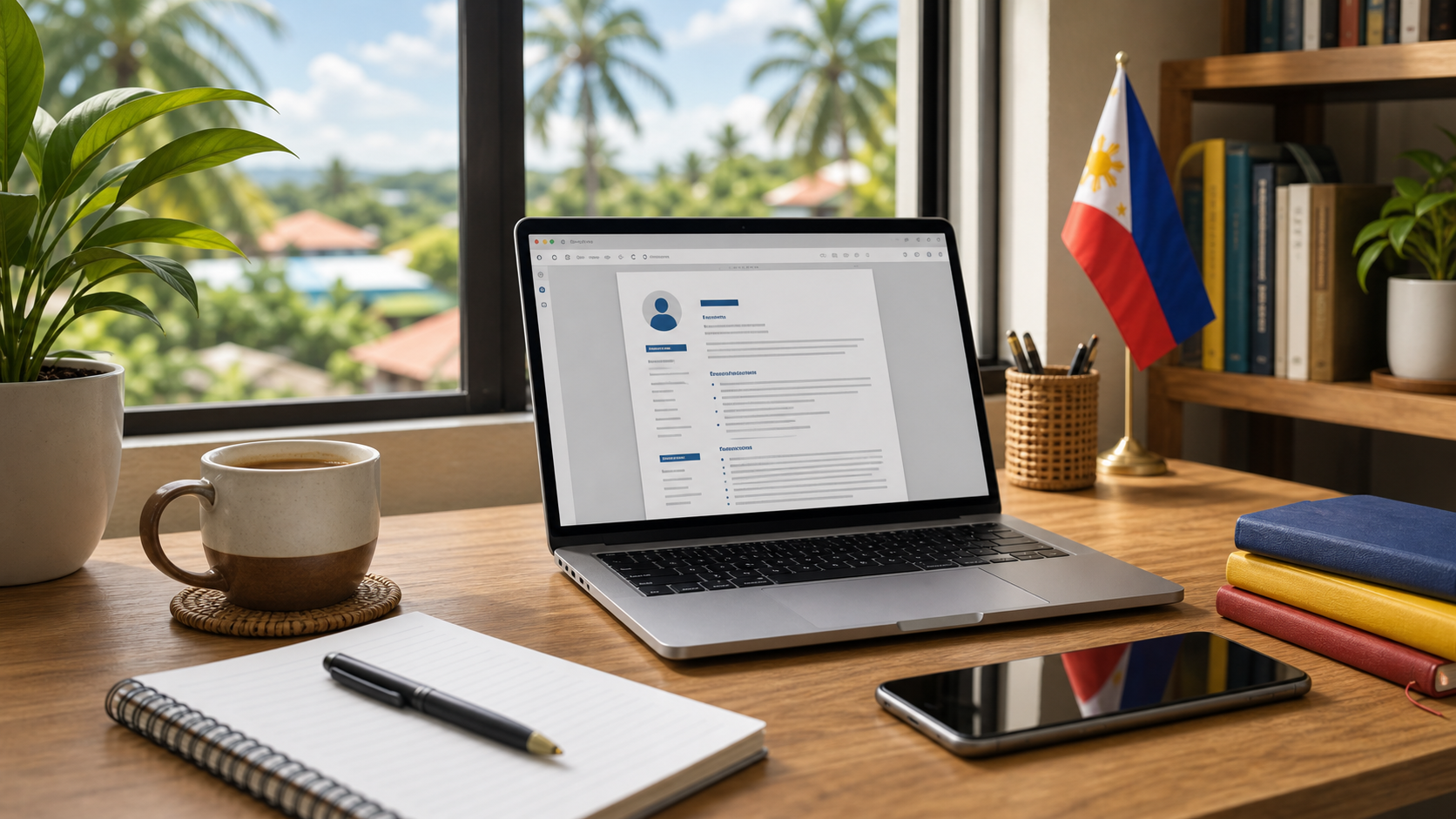
How to Become a VA in the Philippines (No Experience)
A practical beginner roadmap for Filipinos who want to become virtual assistants without prior online work experience.